
We’ve discussed the benefits of different color lights for sleep, but what about sounds?
There is a spectrum of colors, from white noise to brown noise to blue noise.
Our main goal is to help you fall asleep and stay asleep by providing you with information about the various options so you can explore and discover which noise is the most soothing.
While music may be our usual sound of choice, we will explore the humming of white noise, the nature sounds of green noise, the soft tones of pink noise, and more.
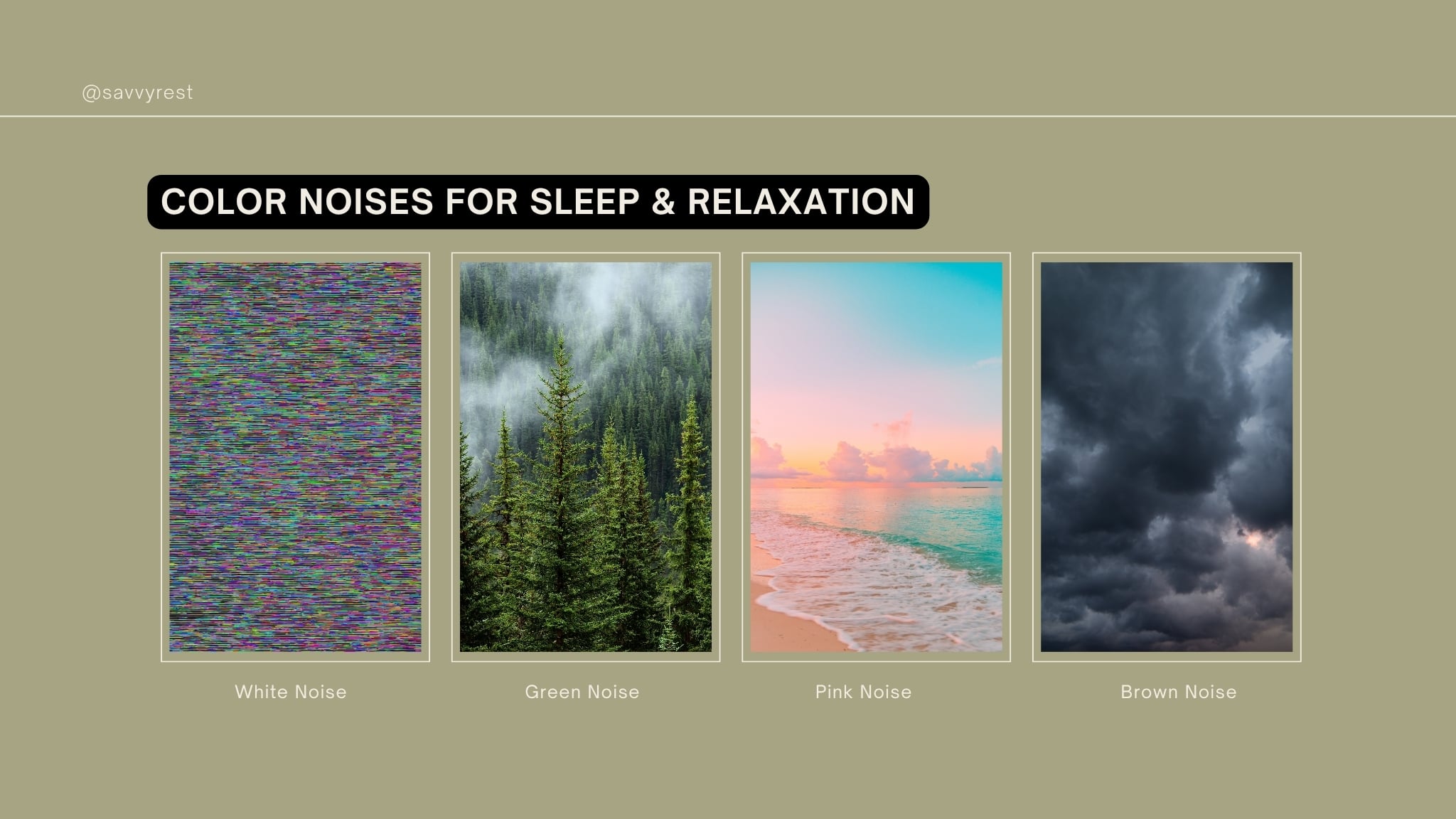
| Types of Noise | White Noise | Green Noise | Pink Noise | Brown Noise |
|---|---|---|---|---|
| Defintion | Includes all sound frequencies at equal volume, drowning out background noises | A type of white noise that focuses more on mid-range frequencies. Very nature-oriented. | Focuses more on low-pitch sounds while softening high-pitch sounds | The deepest sound for sleep that focuses on lower frequencies |
| Best for | Sleep; blocking out unwanted background noises | Sleep, especially if you find traditional white noise to be too stark | Sleep; improving memory | Sleep; background noise to calm the nervous system and decrease anxiety |
| Examples | Fan, air purifier, white noise machine | Light rain, wind, rustling leaves | Ocean waves and steady rainfall | Healing rain and rumbling thunder |
What is White Noise?
White noise is the most well-known sleep sound that includes all sound frequencies at equal volume, essentially drowning out background noises that may disrupt your sleep. White noise machines are designed to mask other sounds through consistent, steady sound, creating a more soothing environment.
A fan is a very common white noise for sleep that also provides the added benefit of keeping you cool.
Static, such as from an older television or radio, is another example of white noise.
The key is continuous, consistent noise that does not vary in pitch. This eliminates sudden sounds that can jolt you awake.
What is Green Noise?
Green noise for sleep is all about nature, as the name suggests. It is also technically considered a type of white noise, focusing more on mid-range frequencies.
Examples of green noise include water sounds, such as waterfalls, rivers, or light rain. Wind and rustling leaves are also other examples of green noise.
There is something innately soothing about nature–perhaps the simplicity of it, or how it represents the complete opposite of our day-to-day lives in office cubicles, attached to a screen. It is a peaceful distraction from our daily stressors, making the sounds of nature the perfect lullaby to drift off to.
If you find traditional white noise to be a little too stark, try green noise.
What is Pink Noise?
Pink noise is similar to white noise in the sense that there is a steady noise that blocks disruptive outside sounds. However, it focuses more on lower-pitch sounds while softening higher-pitch sounds.
Examples of pink noise for sleep include steady rainfall, heartbeats, and ocean waves on the beach.
It is believed that the lower sound frequencies in pink noise are more gentle, and therefore more conducive for sleep, than traditional white noise which includes all frequencies at once.
Studies have also shown that pink noise can help improve memory. TIME published an article detailing a study conducted by Dr. Phyllis Zee, a neurology professor at Northwestern. The 2-night study participants were adults over the age of 60. She chose this age group because they are more at risk of developing memory problems. During the study, pink noise was played during one night of sleep, at different times throughout their sleep cycles without disrupting the participants’ sleep. The study found that those who listened to the pink noise performed significantly better during a memory recall test the following morning (3 times better) than they had when they did not listen to pink noise.
What is Brown Noise?
Brown noise is the deepest sound for sleep. Think of very heavy rain or rumbling thunder. Like pink noise, it embodies the power of lower frequency sounds. However, pink noise is considered warmer and more balanced compared to brown noise since pink noise still has some higher frequencies. Brown noise is strong and bass-heavy.
Brown noise for sleep is viewed as incredibly soothing but it can also be used while you’re awake as background noise to calm your nervous system and decrease anxiety. It can also be used for studying and meditation.
Best Color Noise for Sleep
So, with all this information, what is the best color noise for sleep?
The short answer: there is no best color.
Your sleep experience and preferences are individual to you, meaning what works well for your sleep routine may not work for someone else’s. One person may find the sound of a white noise fan to be too aggressive and disruptive, preferring more subtle nature sounds. Someone else may find the sound of light rain distracting, making them want to get up to use the restroom instead of falling asleep.
We as individuals characterize different sounds as soothing. The best way to find out what sleep noise works best for you is to try them all out. You can even experiment with overlapping sounds. For example, I personally enjoy blending green noise with brown noise – think forest sounds with a crackling campfire.
When I can’t take my sound machines with me on the road (yes, I use two different ones), there are apps you can use. My personal favorite is Better Sleep. This app has a variety of sounds to choose from and allows you to use multiple sounds at once while controlling their intensity. For example, you can choose to listen to a waterfall, with faint wind in the background.
We hope this article, and the descriptions provided, give you a sense of where to start your sleep journey.
Make sure to read more Savvy Rest sleep articles to further continue your research, and always opt for an organic pillow as your number one sleep accessory. What you lay your head on each night is just as important as the sounds you listen to. Your pillow should offer plenty of support without the use of synthetic materials. Learn more about organic bedding options for your sleep oasis.
Learn more about Savvy Rest.
Savvy Rest offers exceptionally crafted organic mattresses, bedding, furniture, and more.
Best-Selling Latex Mattress
Choose Your Serenity Mattress
Our most popular GOTS-certified organic mattress. Couples can customize each side of the Serenity for their own comfort preferences.
Create Your MattressMore like this
Organic Bedding
Savvy Rest offers a complete line of organic and natural bedding. Shop organic cotton sheets, waterproof protectors, latex pillows, and more.
Shop all Organic Bedding